
Over the past few weeks, we have been invited into a very profound season of reflection. Just two weekends ago, many of us gathered to remember those who gave their lives in service to others during Memorial Day, carrying with us the weight of sacrifice, memory, grief, and gratitude, while at the same time we were also celebrating Pentecost, the coming of the Holy Spirit and what many Christians understand as the birth of the Church of Jesus Christ.
Then, only one week later, we celebrated Trinity Sunday, learning once again that at the very center of our faith is a God who exists eternally not in isolation, but in relationship: Creator, Redeemer, and Sustainer; Father, Son, and Holy Spirit living together in communion, love, and shared life.
What if all of this invites us to wonder about our own future as churches? What future is possible for Groveville and Crosswicks? What kind of people are we becoming together? What kind of witness are we being called to offer in a world that often feels increasingly fragmented, fearful, lonely, divided, and exhausted?
One of the most interesting dimensions of Pentecost is that it would not truly begin in Acts 2, but much earlier in Genesis, in the story commonly known as the Tower of Babel (Genesis 11:1-9). There, humanity gathers together in one place and says, “Come, let us build ourselves a city, and a tower with its top in the heavens, and let us make a name for ourselves.” The issue in the story is not simply that human beings desired to build something large or beautiful. Scripture has never been opposed to human creativity. Rather, the deeper issue seems to be humanity’s desire to elevate itself, to secure itself through its own power, and perhaps even to establish systems centered on human glory, control, and self-preservation rather than trust in God and mutual care for one another.
What makes this especially important is that this was not exactly the vocation humanity had originally received from God. In Genesis 1:28, humanity is invited to “fill the earth and subdue it,” language that has often been misunderstood throughout history.
Yet within the broader witness of Scripture, the call seems less about domination and more about stewardship, care, responsibility, and participation in God’s ongoing creation. Human beings were not created to rule over one another through fear and oppression, but to live in relationship with God, with creation, and with one another.
This tension continues throughout the biblical story. Later, in 1 Samuel 8, the people of Israel ask God for a king “like the other nations.” Yet God responds through the prophet Samuel with a warning. Kings, God says, will take your sons for war, your daughters for service, the produce of your labor, and the fruit of your land. In other words, human systems built around centralized power often begin consuming the very people they were supposed to protect. And this is why Pentecost becomes such a beautiful and powerful moment within the Christian story.
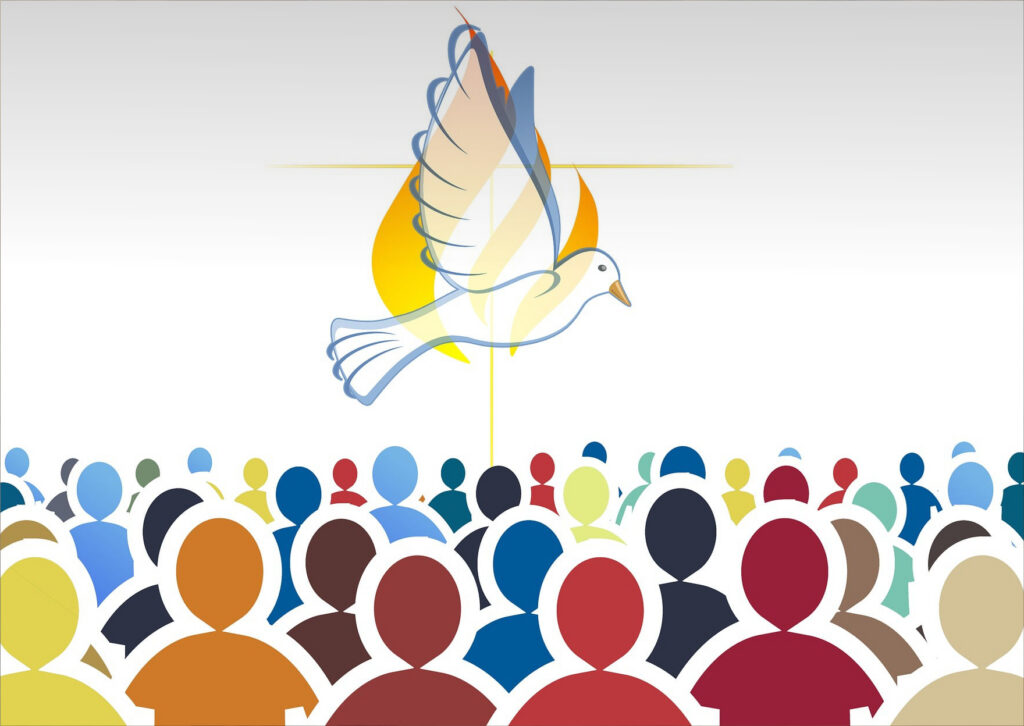
Because after Babel, after languages were confused and humanity found itself divided and unable to understand one another, Jesus comes announcing reconciliation between God and creation, and then promises the coming of the Holy Spirit, the Comforter, who arrives in Acts 2:1-12 like wind and fire among the gathered people.
Yet the miracle of Pentecost is deeply important in the way it unfolds. The Spirit does not erase diversity by making everyone speak the same language or forcing uniformity. Instead, every person hears the Good News in their own language. Parthians, Medes, Elamites, Egyptians, Arabs, and people from many other regions all hear and understand.
How beautiful that is! The Spirit did not destroy difference, but created understanding in the midst of difference.
What if there is something here that the Church still desperately needs to learn today? Because our future may lie in whether we are willing to become communities capable once again of relationship, compassion, hospitality, and genuine love.
The future of Groveville and Crosswicks may very well depend on our willingness to learn how to “speak the languages” of the people around us, not merely linguistically, but spiritually, emotionally, and relationally. We are surrounded by people speaking the languages of loneliness, grief, anxiety, exhaustion, economic uncertainty, spiritual hurt, isolation, and longing for meaning. And the Gospel continues calling the Church to enter those spaces not with fear, arrogance, or superiority, but with humility, presence, and compassion.
This is why relational evangelism and relational discipleship matter so deeply. People are not projects, communities are not strategies, and human beings are not numbers on attendance reports. They are beloved children of God carrying stories, wounds, hopes, fears, questions, and dignity. This is why the Apostle Paul invites the Church in Romans 12:9, “Let love be genuine.” Not performative, manipulative, or transactional love. But real love rooted in the life of the Triune God whose very being is relationship and communion.
This is part of what hope looks like for churches like ours today: Not trying to recreate a past world that no longer exists, but becoming communities where the Holy Spirit continues teaching human beings how to listen to one another again, how to care for one another again, and how to rediscover that the Gospel of Jesus Christ still has the power to bring people together across difference, fear, and division.
I am confident that the Spirit is not finished with Groveville and Crosswicks yet!
Let us continue learning together what this may mean for our churches during our Retreat on June 13, as together we pray, dream, listen, discern, and seek what new thing God may still be doing among us.
Warmly,
Rev. David Gaitan